Wednesday, May 4, 2011


Gorse and bog fires damaging the Irish Environment
In the last week 16 counties have been fighting to quench fires on peat lands or gorse fires. These fires have caused enormous damage to the environment. Fires in Galway, Mayo, Sligo, Donegal and Offaly have caused the most damage. Some fires have been started deliberately but most fires have been caused due to the land been to dry for this time of the year. The recent warm spells have left the ground warmer than average. A cigarette discarded could easily spark off a fire or a piece of shattered glass.
These fires are wrecking havoc on various habitats. Due to herbage been burnt away meaning a loss in food sources. Birdwatch Ireland says 'the last two winters have had a detrimental effect on bird numbers and that the present spate of fires will make it difficult for species to mate again. The loss of food sources such as insects will prove detrimental for birds'.
The organisation believes the most affected species will be, twite, red grouse, grasshopper warbler, whitethroat, linnet, stonechat, dunnock, curlew, blackbird and meadow pipit.
“We are in the middle of the nesting season and tens of thousands of chicks and eggs have been destroyed”,Birdwatch Ireland’s John Murphy stated.
In Donegal and Mayo, the rare Cuckoo has been affected by the worst gorse fires have occurred. Red Grouse is also dangerously affected. The Red grouse is on the Red Data list. It has only over 4,200 individuals(2008). They live in bogs, moors and higher terrains.
One of Ireland's rarest birds the Twite which is common along the west especially in North West and Donegal. It is a finch that lives in areas of heather and gorse.
Gorse fires in Ireland are different to those in other countries. “Gorse and bog fires in Ireland are different in many respects to similar fires in Scotland, for example, as the compacted peat (up to 20ft deep in places) that lies underneath the gorse here continues to smoulder long after the gorse fires have been extinguished. Scotland’s granite terrain means that the gorse fire is faster burning and does not penetrate as deep underground and therefore the effects on wildlife are not as significant. In Ireland, the grass that grows in the aftermath of such fires benefits cattle and sheep only and not the birds and food sources that previously inhabited the area.”
“Another consequence of these fires is that birds in the affected areas have been forced to relocate in large numbers to secondary habitats, where resources are limited and the terrain is less suitable”, John Murphy-Birdwatch Ireland
These fires are wrecking havoc on various habitats. Due to herbage been burnt away meaning a loss in food sources. Birdwatch Ireland says 'the last two winters have had a detrimental effect on bird numbers and that the present spate of fires will make it difficult for species to mate again. The loss of food sources such as insects will prove detrimental for birds'.
The organisation believes the most affected species will be, twite, red grouse, grasshopper warbler, whitethroat, linnet, stonechat, dunnock, curlew, blackbird and meadow pipit.
“We are in the middle of the nesting season and tens of thousands of chicks and eggs have been destroyed”,Birdwatch Ireland’s John Murphy stated.
In Donegal and Mayo, the rare Cuckoo has been affected by the worst gorse fires have occurred. Red Grouse is also dangerously affected. The Red grouse is on the Red Data list. It has only over 4,200 individuals(2008). They live in bogs, moors and higher terrains.
One of Ireland's rarest birds the Twite which is common along the west especially in North West and Donegal. It is a finch that lives in areas of heather and gorse.
Gorse fires in Ireland are different to those in other countries. “Gorse and bog fires in Ireland are different in many respects to similar fires in Scotland, for example, as the compacted peat (up to 20ft deep in places) that lies underneath the gorse here continues to smoulder long after the gorse fires have been extinguished. Scotland’s granite terrain means that the gorse fire is faster burning and does not penetrate as deep underground and therefore the effects on wildlife are not as significant. In Ireland, the grass that grows in the aftermath of such fires benefits cattle and sheep only and not the birds and food sources that previously inhabited the area.”
“Another consequence of these fires is that birds in the affected areas have been forced to relocate in large numbers to secondary habitats, where resources are limited and the terrain is less suitable”, John Murphy-Birdwatch Ireland
Thursday, April 28, 2011
All about Tornado's
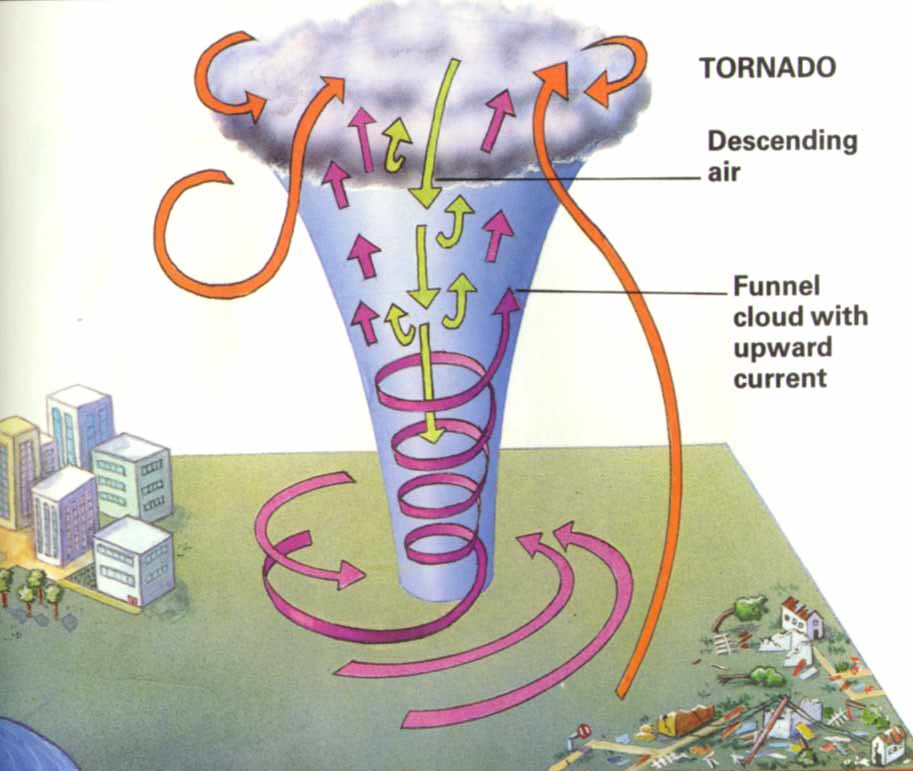
A Tornado or Cyclone is a violent, dangerous, rotating column of air. It is in contact with the surface of the earth and cumulonimbus clouds. In rare cases cumulus clouds. Tornado's come in various shapes and sizes. It's main shape is a visible Condensation funnel, whose narrow end touches the surface of the earth.
Most tornado's have a speed of at least 110 mph (177 km/h). They are approximately 250 feet(80 m) across and can travel several miles/kilometres before dissipating.
A tornado is not always visible. A funnel cloud or Condensation cloud is it's most common feature. It is formed at intense low pressure causing high speeds(Bernoulli's Principle) and rapid rotation due to cyclostrophic balance, which causes water vapour in the air to become visible as a cloud. It is funnel shape.
Tornado's vary in size. Some are narrow, others are much larger. Small tornado's are weak. There may be a small swirl of dust. Average speed is 40 mph or 64 km/h. A 'stovepipe' is a cylindrical tornado. It can appear wedge like.
Tornado's rotate cyclonically(Anti Clockwise in the Northern Hemisphere and clockwise in the Southern Hemisphere). This is because of the Coriolis affect. A tornado has a rumbling sound.
The colour is determined by it's environment. In a dry environment it is nearly all visible, if over water it can be blue or white. The type of soil may also contribute to the colour. The time of day will affect colour also.
The life cycle is broken up into different stages. Formation, Maturity, Demise.
Formation:
As the mesocyclone approaches the ground, a visible condensation funnel appears to descend from the base of the storm, often from a rotating wall cloud.As the funnel descends, the RFD(Rear flank downdraft) also reaches the ground, creating a gust front that can cause damage a good distance from the tornado. Usually, the funnel cloud becomes a tornado within minutes of the RFD reaching the ground.
Maturity:
When the tornado has a good source of warm, moist inflow to power it, so it grows until it reaches the "mature stage". This can last minutes to hours. This is the stage that causes most damage. The RFD now an area of cool surface winds, begins to wrap around the tornado, cutting off the inflow of warm air which feeds the tornado.
Demise:
As the RFD completely wraps around and chokes off the tornado's air supply, the vortex begins to weaken, and become thin and rope-like. This is the "dissipating stage"; often lasting no more than a few minutes, after which the tornado fizzles. The storm is contracting into a rope-like tube and, like the ice skater who pulls her arms in to spin faster, winds can increase at this point. As the tornado enters the dissipating stage, its associated mesocyclone often weakens as well, as the rear flank downdraft cuts off the inflow powering it.
The Fujita scale and the Enhanced Fujita Scale rate tornadoes by damage caused. The Enhanced Fujita (EF) Scale was an upgrade to the older Fujita scale, by expert elicitation, using engineered wind estimates and better damage descriptions. The EF Scale was designed so that a tornado rated on the Fujita scale would receive the same numerical rating. An EF0 tornado will probably damage trees but not substantial structures, whereas an EF5 tornado can rip buildings off their foundations leaving them bare and even deform large skyscrapers. The similar TORRO scale ranges from a T0 for extremely weak tornadoes to T11 for the most powerful known tornadoes.


Most tornado's have a speed of at least 110 mph (177 km/h). They are approximately 250 feet(80 m) across and can travel several miles/kilometres before dissipating.
A tornado is not always visible. A funnel cloud or Condensation cloud is it's most common feature. It is formed at intense low pressure causing high speeds(Bernoulli's Principle) and rapid rotation due to cyclostrophic balance, which causes water vapour in the air to become visible as a cloud. It is funnel shape.
Tornado's vary in size. Some are narrow, others are much larger. Small tornado's are weak. There may be a small swirl of dust. Average speed is 40 mph or 64 km/h. A 'stovepipe' is a cylindrical tornado. It can appear wedge like.
Tornado's rotate cyclonically(Anti Clockwise in the Northern Hemisphere and clockwise in the Southern Hemisphere). This is because of the Coriolis affect. A tornado has a rumbling sound.
The colour is determined by it's environment. In a dry environment it is nearly all visible, if over water it can be blue or white. The type of soil may also contribute to the colour. The time of day will affect colour also.
The life cycle is broken up into different stages. Formation, Maturity, Demise.
Formation:
As the mesocyclone approaches the ground, a visible condensation funnel appears to descend from the base of the storm, often from a rotating wall cloud.As the funnel descends, the RFD(Rear flank downdraft) also reaches the ground, creating a gust front that can cause damage a good distance from the tornado. Usually, the funnel cloud becomes a tornado within minutes of the RFD reaching the ground.
Maturity:
When the tornado has a good source of warm, moist inflow to power it, so it grows until it reaches the "mature stage". This can last minutes to hours. This is the stage that causes most damage. The RFD now an area of cool surface winds, begins to wrap around the tornado, cutting off the inflow of warm air which feeds the tornado.
Demise:
As the RFD completely wraps around and chokes off the tornado's air supply, the vortex begins to weaken, and become thin and rope-like. This is the "dissipating stage"; often lasting no more than a few minutes, after which the tornado fizzles. The storm is contracting into a rope-like tube and, like the ice skater who pulls her arms in to spin faster, winds can increase at this point. As the tornado enters the dissipating stage, its associated mesocyclone often weakens as well, as the rear flank downdraft cuts off the inflow powering it.
The Fujita scale and the Enhanced Fujita Scale rate tornadoes by damage caused. The Enhanced Fujita (EF) Scale was an upgrade to the older Fujita scale, by expert elicitation, using engineered wind estimates and better damage descriptions. The EF Scale was designed so that a tornado rated on the Fujita scale would receive the same numerical rating. An EF0 tornado will probably damage trees but not substantial structures, whereas an EF5 tornado can rip buildings off their foundations leaving them bare and even deform large skyscrapers. The similar TORRO scale ranges from a T0 for extremely weak tornadoes to T11 for the most powerful known tornadoes.

Tuesday, April 26, 2011
Chernobyl 25 years on
On the 26th of April 1986 at 1:23:45 am Moscow time the worst nuclear disaster occurred. The plant is located in Pripyat, Ukraine. Reactor four suffered a catastrophic power increase which resulted to the core exploding. Vast amounts of radioactive fuel and materials were released into the atmosphere and ignited the graphite moderator. The burning of graphite increased the amount of radiation particles. The disaster was an experiment to test the safety of the emergency cooling of the core.
Shortly after the accident fire fighters arrived to extinguish the fire. The men were not told of the dangerous radiation that face them. They were told it was an electrical fire. The fires would not be quenched until 6.35 am. A witness is said that after the fire fighters finished they could 'taste metal' and 'had pins and needles all over their faces'.
Hundreds and thousands of people were evacuated from the area. But yet the people had been affected. Some thousands of children developed thyroid and other cancers due to the mutilation of cells. Animals and nature suffered as a result also. In some parts, entire forests have been destroyed.
In over 25 years only 3% of the reactors deadly radiation has leaked. People worry if so much damage is done by the 3% then what will happen after the other 97%? A shelter/dome which surrounds the reactor which encases the radiation is now beginning to degrade. An estimate of $1.2 billion dollars is needed to create a new shelter.
We must ask ourselves; Do we want a future Chernobyl? No. That is why we Must now more than ever use Renewable energy
This website has pictures of areas near Chernobyl http://totallycoolpix.com/2011/01/chernobyl-25-years-later/

Shortly after the accident fire fighters arrived to extinguish the fire. The men were not told of the dangerous radiation that face them. They were told it was an electrical fire. The fires would not be quenched until 6.35 am. A witness is said that after the fire fighters finished they could 'taste metal' and 'had pins and needles all over their faces'.
Hundreds and thousands of people were evacuated from the area. But yet the people had been affected. Some thousands of children developed thyroid and other cancers due to the mutilation of cells. Animals and nature suffered as a result also. In some parts, entire forests have been destroyed.
In over 25 years only 3% of the reactors deadly radiation has leaked. People worry if so much damage is done by the 3% then what will happen after the other 97%? A shelter/dome which surrounds the reactor which encases the radiation is now beginning to degrade. An estimate of $1.2 billion dollars is needed to create a new shelter.
We must ask ourselves; Do we want a future Chernobyl? No. That is why we Must now more than ever use Renewable energy
This website has pictures of areas near Chernobyl http://totallycoolpix.com/2011/01/chernobyl-25-years-later/

Sunday, April 24, 2011

Friday, April 22, 2011
Earth Day 2011
Today is Earth Day. Today is a day to consider our environment. By doing simple tasks every day we can make a difference. By taking part in this event you are making a stand to save our only world. Just my turning off all the lights you can make an impact. Maybe plant a tree or flowers? Clean up your town? Raise money for an environmental society? Begin a green school campaign? The list is endless.
For more information: http://www.earthday.org/earth-day-2011
Remember: Keep the Environment clean, go green!

For more information: http://www.earthday.org/earth-day-2011
Remember: Keep the Environment clean, go green!

Wednesday, April 20, 2011
Subscribe to:
Posts (Atom)