Tonight the skies will be witness to a Supermoon or Large Full moon. Tonight's full moon will appear 14% larger and 30% brighter than usual. A supermoon occurs when the moon hits its full phase while also making its closest approach to Earth for the month, called a perigee. The moon will be within 221,802 miles(356,955.72 km) of Earth — its closest approach of the year.
The most recent supermoon, in March 2011, was the biggest and brightest full moon in 18 years.
David Kriegler of the University of Nebraska said "there have been about 12 supermoons since 1954, or about one every five years"
So why not step outside and enjoy the spectacular sights in the sky tonight!
Other key astronomical events for May are:
May 20
Annular solar eclipse. The path of annularity will begin in southern China and move east through Japan, the northern Pacific Ocean, and into the western United States. A partial eclipse will be visible throughout parts of eastern Asia and most of North America.
May 25
Penumbral lunar eclipse. The eclipse will be visible throughout most of North America, South America, western Europe and western Africa
May 28
Conjunction of Venus and Jupiter. The two bright planets will be within 1 degree of each other in the evening sky. The planet Mercury will also be visible nearby. Look to the west near sunset.
Search our Blog
Saturday, May 5, 2012
Thursday, May 3, 2012
Irish bathing water quality improved in 2011
THE QUALITY OF bathing water in Ireland improved between 2010 and 2011, a new report shows. Minister for the Environment, Community and Local Government, Phil Hogan, TD welcomed the publication of the Environmental Protection Agency’s (EPA) The Quality of Bathing Water in Ireland overview for 2011.
The report noted that there was a net decrease of six locations complying with the higher ‘guide’ standard.
The results for the 2011 bathing season show that overall, the quality of bathing water in Ireland improved in comparison with the 2010 equivalent. Overall, 98.5 per cent (133 out of 135) of bathing areas complied with the EU mandatory standard, equating to ‘sufficient’ water quality. This is the highest number complying with the EU mandatory standard since 2000.
83 per cent (112 bathing areas) achieved the higher guide standard, equating to ‘good’ water quality.
In 2011, five new beaches were identified and the number of designated bathing waters increased for the first time in Ireland in 10 years, rising to 135.
In 2011 the Bathing Water Quality Regulations, which were introduced in 2008, become operational.
Minister Hogan said Ireland will have to redouble its efforts to maintain and improve bathing water quality standards. The stricter criteria in the higher guide standard requires local authorities to make extra efforts to improve the water quality and to tackle any potential sources of pollution.
The report noted that there was a net decrease of six locations complying with the higher ‘guide’ standard.
The results for the 2011 bathing season show that overall, the quality of bathing water in Ireland improved in comparison with the 2010 equivalent. Overall, 98.5 per cent (133 out of 135) of bathing areas complied with the EU mandatory standard, equating to ‘sufficient’ water quality. This is the highest number complying with the EU mandatory standard since 2000.
83 per cent (112 bathing areas) achieved the higher guide standard, equating to ‘good’ water quality.
In 2011, five new beaches were identified and the number of designated bathing waters increased for the first time in Ireland in 10 years, rising to 135.
In 2011 the Bathing Water Quality Regulations, which were introduced in 2008, become operational.
Minister Hogan said Ireland will have to redouble its efforts to maintain and improve bathing water quality standards. The stricter criteria in the higher guide standard requires local authorities to make extra efforts to improve the water quality and to tackle any potential sources of pollution.
Monday, April 30, 2012
White-tailed Eagles make Co.Clare their new nest after 100-year wait
A pair of White-tailed Eagles has begun nesting in Co. Clare. They are breeding near Mountshannon, in what is the first documented nesting attempt for the species in Ireland in over 100 years. Nest building began in recent weeks, with the birds spending time in and around the nest site before laying eggs. The breeding pair are a four year old male and three year old female who were collected on the island of Frøya off the west coast of Norway and settled in the Mounshannon area in early 2011.
The White-tailed Sea Eagle was driven to extinction from Ireland in the early 20thcentury.
The pair was released in Killarney National Park, Co Kerry, as part of the White-tailed Eagle reintroduction programme and developed and funded by the Department of Arts, Heritage and the Gaeltacht in partnership with Golden Eagle trust.
Dr Allan Mee, project manager for the Golden Eagle Trust, described it as “a truly momentous event for Clare and Ireland”.
Although people may want to see the birds, they are warned that disturbance, particularly during the early stages of nesting when the birds are on eggs, would be detrimental to the pair’s success.
Dr Mee explained:
"We are very conscious of the risk of disturbing the birds especially at this stage of nesting. Disturbance could result in the birds leaving the eggs unguarded for a period during which the eggs could be predated or be chilled or the birds could desert the site. We would caution people not to approach the nest area but instead avail of the unique opportunity to watch a nesting pair of sea eagles from nearby Mountshannon pier where a telescope or binoculars will be made available for viewing by the Golden Eagle Trust. Information on the birds, their ecology and conservation will be available."
Birds can live for 25-30 years and generally mate for life with adult pairs remaining within their home range throughout the year.
The White-tailed Sea Eagle was driven to extinction from Ireland in the early 20thcentury.
The pair was released in Killarney National Park, Co Kerry, as part of the White-tailed Eagle reintroduction programme and developed and funded by the Department of Arts, Heritage and the Gaeltacht in partnership with Golden Eagle trust.
Dr Allan Mee, project manager for the Golden Eagle Trust, described it as “a truly momentous event for Clare and Ireland”.
Although people may want to see the birds, they are warned that disturbance, particularly during the early stages of nesting when the birds are on eggs, would be detrimental to the pair’s success.
Dr Mee explained:
"We are very conscious of the risk of disturbing the birds especially at this stage of nesting. Disturbance could result in the birds leaving the eggs unguarded for a period during which the eggs could be predated or be chilled or the birds could desert the site. We would caution people not to approach the nest area but instead avail of the unique opportunity to watch a nesting pair of sea eagles from nearby Mountshannon pier where a telescope or binoculars will be made available for viewing by the Golden Eagle Trust. Information on the birds, their ecology and conservation will be available."
Birds can live for 25-30 years and generally mate for life with adult pairs remaining within their home range throughout the year.
Thursday, April 26, 2012
Have you any comments about Green Sligo??
We would like to hear from you.
Any suggestions to improve our blog? Topics we should cover?
Tuesday, April 24, 2012
Saturday, December 24, 2011
Tuesday, November 8, 2011
Radioactivity in the Environment
*Radioactivity is the spontaneous decay of unstable nuclei, accompanied by the emission of radiation.
There are three types of radiation emitted by radioactive isotopes.
- Alpha particles (α)
- Beta particles (β)
- Gamma rays (γ)
Alpha (α)
*Alpha particles are helium nuclei, with a positive charge and little penetrating ability.
Alpha particles consist of two protons and two neutrons. They can be stopped easily, human skin or a few sheets of paper. If alpha particles enter the body(ingestion) it can be hazardous. An example is americium-241, used in smoke detectors.
Beta (β)
*Beta particles are electrons, with a negative charge and greater penetrating ability than alpha particles.
In some radioactive elements, neutrons disintegrate into protons and electrons. The electrons -β particles are emitted from the atom fast. They can be stopped by 2-3 mm thickness of aluminium. An example is Carbon-14 which is used in dating of artefacts.
Gamma (γ)
*Gamma rays are high energy electromagnetic radiation, with greater penetrating ability than beta and alpha.
This type of radioactivity is emitted by isotopes in a form of rays. They have no mass or charge. They move very quickly and have a strong penetrating ability. A thick shield of concrete or lead can stop them. An example is cobalt-60 which is used in cancer treatment and food irradiation.
Half-life t½
*The half-life of a radioactive isotope is the time taken for half of the atoms in a sample of the isotope to decay.
Different elements have different half lives. For example: Carbon-14 has a half-life of 5,730 years. Uranium-238 has a half-life of 4.5 billion years! For a radioactive atom to fully disintegrate it must go though 10 and a half half-life's
Background Radiation
We are all exposed all the time to some radiation, called background radiation. It is natural and fund from:
- Cosmic Radiation
- Rocks-containing traces of uranium and its decay product Radon. Granite rock releases Radon. It can accumulate in houses to levels that increase of lung cancer.
- Man made radioactive materials.
Natural Radiation
- 87% of background radiation.
- Produce natural radiation.
- Many radioactive atoms that once existed have now emitted radiation and have now become non-reactive.
- Examples, Uranium, Radon and Thorium.
Radon
Atomic number 86, symbol Rn, noble gas. Radon is responsible for the majority of public exposure ionizing radiation. It is the largest contribution to an individual's background radiation dose and varies from location. Radon is a gas and can accumulate in a building especially in a confined room such as attics. Epidemiological studies have shown a link between breathing high concentrations or radon gas and lung cancer. You can measure radon in your home by placing two small detectors in your home for three months. One is placed in the main bedroom and the other in the living room. After three months the detectors are returned to the lab. A report will be issued indicating the average level of radon and advice on what to do if the level is high.
Links:
http://www.rpii.ie/Measurement-Services/Radon-Measurement/Services/Apply-For-Measurement-Online.aspx
Asteroid to pass over the Earth
An asteroid bigger than an aircraft carrier will brush past the Earth within the next few hours.
The 400-metre (437-yard) wide asteroid, called 2005 YU55, will speed past the planet at a distance of 201,700 miles - closer than the moon.
It Is our closest encounter with such a large space rock in three decades.
But Marina Brozovic of Nasa said there is no cause for alarm.
"It is not going to hit us," she said.
"We have a good idea of its orbit for the next 100 years and the is no chance of impact."
The asteroid was discovered in April 2010, when observations with the Arecibo radar telescope revealed a fuzzy image of the rock tumbling through space.
Nasa is hoping to take much higher resolution photographs of its dark surface as it passes by at 23.28 GMT time on November 8.
Amateur astronomers will need a six-inch telescope to stand a chance of seeing the asteroid, but have been warned that it is moving so fast that it will be difficult to track.
Nasa has set up a near earth object programme known as Spaceguard to locate the estimated 1,000 asteroids and comets larger than 1km (1,093 yards) in diameter - large enough to cause mass extinction of most life on Earth.
Monday, November 7, 2011
Monday, October 31, 2011
Saturday, October 29, 2011
A Hallowe'en treat!
This Hallowe'en will see a unique event. The Earth's global population will reach 7 Billion! It is estimated that it will reach the major landmark on 1:49 pm Monday. Research shows that that on average 150 people a minute are born. This rate is expected to increase. It is expected that the global population will reach 8 Billion in 2027 and 9 Billion by 2046.
The global population in 1804 reached 1 Billion. It would be over 150 years until the numbers began to grow significantly.
What has led to this rising population?
China has a massive 19.3% of the global population with India following at 17%. The USA has 4.48%. The United Kingdom has 0.89% The lowest ranking is Vatican City with 0.00001%(800 people). Ireland has 0.066%(nearly 4.6 million). The continent with the largest population is Asia with 60%(4 billion) with Africa the second most populated(1 billion). Europe makes up 11% with the Americas totalling 14%(South America has 9% and Northern America 5%). Oceania is the least populated with 0.5%
The global population in 1804 reached 1 Billion. It would be over 150 years until the numbers began to grow significantly.
What has led to this rising population?
- Better living standards.
- Higher life expectancy
- People are more fertile.
- Popularity of the need for a larger family.
China has a massive 19.3% of the global population with India following at 17%. The USA has 4.48%. The United Kingdom has 0.89% The lowest ranking is Vatican City with 0.00001%(800 people). Ireland has 0.066%(nearly 4.6 million). The continent with the largest population is Asia with 60%(4 billion) with Africa the second most populated(1 billion). Europe makes up 11% with the Americas totalling 14%(South America has 9% and Northern America 5%). Oceania is the least populated with 0.5%
What does this all mean for the Environment?
The only victim of this story is the environment. How? Every new person who is born needs, food, water, and energy. The world has the capacity to feed all these people for a short term. But the population is not stressing the planet it is our energy demand. We need to become more sustainable with our energy. With the global population growing and energy sources depleting how will earth be able to cope? Will it result in more war?
With human population growing animal life decreases. A study last year found that 52 species of mammals, birds and amphibians moved one category closer to extinction. For example the global tiger population has dropped by 95% to 3,200.
So, if we can live more sustainably and more environmentally friendly we should welcome the 7 billionth newcomer on Monday!
Wednesday, October 26, 2011
Dublin floods
| Floods cause travel difficulties |
Many people woke up to find water in their homes. One resident in Tallaght said, "I've never seen anything like this in the last day in 38 years. I'm living in Tallaght 43 years and I've never seen anything as bad as this."
Roads have been closed, public transport has been halted, shops and business's have been submerged in water.
The floods have taken the lives of two people. A local Garda aged 25 and a young Filipino woman living in Dublin.
As the floods begin to recede the cost of the damage is estimated to be around 100s of millions of euro.
Wednesday, May 4, 2011
Gorse and bog fires damaging the Irish Environment
In the last week 16 counties have been fighting to quench fires on peat lands or gorse fires. These fires have caused enormous damage to the environment. Fires in Galway, Mayo, Sligo, Donegal and Offaly have caused the most damage. Some fires have been started deliberately but most fires have been caused due to the land been to dry for this time of the year. The recent warm spells have left the ground warmer than average. A cigarette discarded could easily spark off a fire or a piece of shattered glass.
These fires are wrecking havoc on various habitats. Due to herbage been burnt away meaning a loss in food sources. Birdwatch Ireland says 'the last two winters have had a detrimental effect on bird numbers and that the present spate of fires will make it difficult for species to mate again. The loss of food sources such as insects will prove detrimental for birds'.
The organisation believes the most affected species will be, twite, red grouse, grasshopper warbler, whitethroat, linnet, stonechat, dunnock, curlew, blackbird and meadow pipit.
“We are in the middle of the nesting season and tens of thousands of chicks and eggs have been destroyed”,Birdwatch Ireland’s John Murphy stated.
In Donegal and Mayo, the rare Cuckoo has been affected by the worst gorse fires have occurred. Red Grouse is also dangerously affected. The Red grouse is on the Red Data list. It has only over 4,200 individuals(2008). They live in bogs, moors and higher terrains.
One of Ireland's rarest birds the Twite which is common along the west especially in North West and Donegal. It is a finch that lives in areas of heather and gorse.
Gorse fires in Ireland are different to those in other countries. “Gorse and bog fires in Ireland are different in many respects to similar fires in Scotland, for example, as the compacted peat (up to 20ft deep in places) that lies underneath the gorse here continues to smoulder long after the gorse fires have been extinguished. Scotland’s granite terrain means that the gorse fire is faster burning and does not penetrate as deep underground and therefore the effects on wildlife are not as significant. In Ireland, the grass that grows in the aftermath of such fires benefits cattle and sheep only and not the birds and food sources that previously inhabited the area.”
“Another consequence of these fires is that birds in the affected areas have been forced to relocate in large numbers to secondary habitats, where resources are limited and the terrain is less suitable”, John Murphy-Birdwatch Ireland
These fires are wrecking havoc on various habitats. Due to herbage been burnt away meaning a loss in food sources. Birdwatch Ireland says 'the last two winters have had a detrimental effect on bird numbers and that the present spate of fires will make it difficult for species to mate again. The loss of food sources such as insects will prove detrimental for birds'.
The organisation believes the most affected species will be, twite, red grouse, grasshopper warbler, whitethroat, linnet, stonechat, dunnock, curlew, blackbird and meadow pipit.
“We are in the middle of the nesting season and tens of thousands of chicks and eggs have been destroyed”,Birdwatch Ireland’s John Murphy stated.
In Donegal and Mayo, the rare Cuckoo has been affected by the worst gorse fires have occurred. Red Grouse is also dangerously affected. The Red grouse is on the Red Data list. It has only over 4,200 individuals(2008). They live in bogs, moors and higher terrains.
One of Ireland's rarest birds the Twite which is common along the west especially in North West and Donegal. It is a finch that lives in areas of heather and gorse.
Gorse fires in Ireland are different to those in other countries. “Gorse and bog fires in Ireland are different in many respects to similar fires in Scotland, for example, as the compacted peat (up to 20ft deep in places) that lies underneath the gorse here continues to smoulder long after the gorse fires have been extinguished. Scotland’s granite terrain means that the gorse fire is faster burning and does not penetrate as deep underground and therefore the effects on wildlife are not as significant. In Ireland, the grass that grows in the aftermath of such fires benefits cattle and sheep only and not the birds and food sources that previously inhabited the area.”
“Another consequence of these fires is that birds in the affected areas have been forced to relocate in large numbers to secondary habitats, where resources are limited and the terrain is less suitable”, John Murphy-Birdwatch Ireland
Thursday, April 28, 2011
All about Tornado's
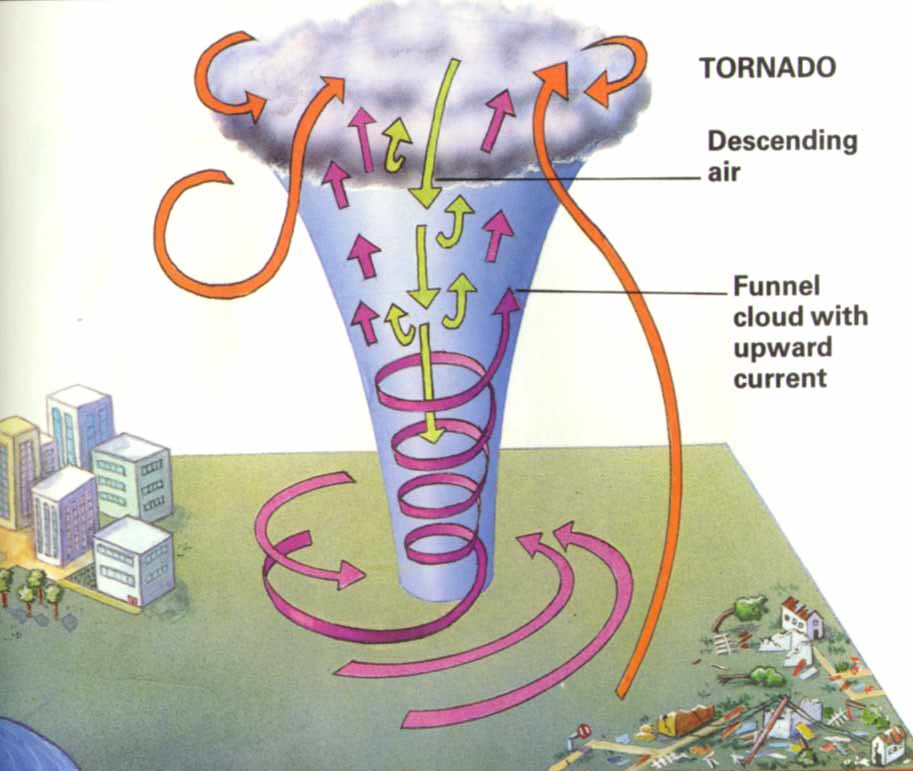
A Tornado or Cyclone is a violent, dangerous, rotating column of air. It is in contact with the surface of the earth and cumulonimbus clouds. In rare cases cumulus clouds. Tornado's come in various shapes and sizes. It's main shape is a visible Condensation funnel, whose narrow end touches the surface of the earth.
Most tornado's have a speed of at least 110 mph (177 km/h). They are approximately 250 feet(80 m) across and can travel several miles/kilometres before dissipating.
A tornado is not always visible. A funnel cloud or Condensation cloud is it's most common feature. It is formed at intense low pressure causing high speeds(Bernoulli's Principle) and rapid rotation due to cyclostrophic balance, which causes water vapour in the air to become visible as a cloud. It is funnel shape.
Tornado's vary in size. Some are narrow, others are much larger. Small tornado's are weak. There may be a small swirl of dust. Average speed is 40 mph or 64 km/h. A 'stovepipe' is a cylindrical tornado. It can appear wedge like.
Tornado's rotate cyclonically(Anti Clockwise in the Northern Hemisphere and clockwise in the Southern Hemisphere). This is because of the Coriolis affect. A tornado has a rumbling sound.
The colour is determined by it's environment. In a dry environment it is nearly all visible, if over water it can be blue or white. The type of soil may also contribute to the colour. The time of day will affect colour also.
The life cycle is broken up into different stages. Formation, Maturity, Demise.
Formation:
As the mesocyclone approaches the ground, a visible condensation funnel appears to descend from the base of the storm, often from a rotating wall cloud.As the funnel descends, the RFD(Rear flank downdraft) also reaches the ground, creating a gust front that can cause damage a good distance from the tornado. Usually, the funnel cloud becomes a tornado within minutes of the RFD reaching the ground.
Maturity:
When the tornado has a good source of warm, moist inflow to power it, so it grows until it reaches the "mature stage". This can last minutes to hours. This is the stage that causes most damage. The RFD now an area of cool surface winds, begins to wrap around the tornado, cutting off the inflow of warm air which feeds the tornado.
Demise:
As the RFD completely wraps around and chokes off the tornado's air supply, the vortex begins to weaken, and become thin and rope-like. This is the "dissipating stage"; often lasting no more than a few minutes, after which the tornado fizzles. The storm is contracting into a rope-like tube and, like the ice skater who pulls her arms in to spin faster, winds can increase at this point. As the tornado enters the dissipating stage, its associated mesocyclone often weakens as well, as the rear flank downdraft cuts off the inflow powering it.
The Fujita scale and the Enhanced Fujita Scale rate tornadoes by damage caused. The Enhanced Fujita (EF) Scale was an upgrade to the older Fujita scale, by expert elicitation, using engineered wind estimates and better damage descriptions. The EF Scale was designed so that a tornado rated on the Fujita scale would receive the same numerical rating. An EF0 tornado will probably damage trees but not substantial structures, whereas an EF5 tornado can rip buildings off their foundations leaving them bare and even deform large skyscrapers. The similar TORRO scale ranges from a T0 for extremely weak tornadoes to T11 for the most powerful known tornadoes.
Most tornado's have a speed of at least 110 mph (177 km/h). They are approximately 250 feet(80 m) across and can travel several miles/kilometres before dissipating.
A tornado is not always visible. A funnel cloud or Condensation cloud is it's most common feature. It is formed at intense low pressure causing high speeds(Bernoulli's Principle) and rapid rotation due to cyclostrophic balance, which causes water vapour in the air to become visible as a cloud. It is funnel shape.
Tornado's vary in size. Some are narrow, others are much larger. Small tornado's are weak. There may be a small swirl of dust. Average speed is 40 mph or 64 km/h. A 'stovepipe' is a cylindrical tornado. It can appear wedge like.
Tornado's rotate cyclonically(Anti Clockwise in the Northern Hemisphere and clockwise in the Southern Hemisphere). This is because of the Coriolis affect. A tornado has a rumbling sound.
The colour is determined by it's environment. In a dry environment it is nearly all visible, if over water it can be blue or white. The type of soil may also contribute to the colour. The time of day will affect colour also.
The life cycle is broken up into different stages. Formation, Maturity, Demise.
Formation:
As the mesocyclone approaches the ground, a visible condensation funnel appears to descend from the base of the storm, often from a rotating wall cloud.As the funnel descends, the RFD(Rear flank downdraft) also reaches the ground, creating a gust front that can cause damage a good distance from the tornado. Usually, the funnel cloud becomes a tornado within minutes of the RFD reaching the ground.
Maturity:
When the tornado has a good source of warm, moist inflow to power it, so it grows until it reaches the "mature stage". This can last minutes to hours. This is the stage that causes most damage. The RFD now an area of cool surface winds, begins to wrap around the tornado, cutting off the inflow of warm air which feeds the tornado.
Demise:
As the RFD completely wraps around and chokes off the tornado's air supply, the vortex begins to weaken, and become thin and rope-like. This is the "dissipating stage"; often lasting no more than a few minutes, after which the tornado fizzles. The storm is contracting into a rope-like tube and, like the ice skater who pulls her arms in to spin faster, winds can increase at this point. As the tornado enters the dissipating stage, its associated mesocyclone often weakens as well, as the rear flank downdraft cuts off the inflow powering it.
The Fujita scale and the Enhanced Fujita Scale rate tornadoes by damage caused. The Enhanced Fujita (EF) Scale was an upgrade to the older Fujita scale, by expert elicitation, using engineered wind estimates and better damage descriptions. The EF Scale was designed so that a tornado rated on the Fujita scale would receive the same numerical rating. An EF0 tornado will probably damage trees but not substantial structures, whereas an EF5 tornado can rip buildings off their foundations leaving them bare and even deform large skyscrapers. The similar TORRO scale ranges from a T0 for extremely weak tornadoes to T11 for the most powerful known tornadoes.
Tuesday, April 26, 2011
Chernobyl 25 years on
On the 26th of April 1986 at 1:23:45 am Moscow time the worst nuclear disaster occurred. The plant is located in Pripyat, Ukraine. Reactor four suffered a catastrophic power increase which resulted to the core exploding. Vast amounts of radioactive fuel and materials were released into the atmosphere and ignited the graphite moderator. The burning of graphite increased the amount of radiation particles. The disaster was an experiment to test the safety of the emergency cooling of the core.
Shortly after the accident fire fighters arrived to extinguish the fire. The men were not told of the dangerous radiation that face them. They were told it was an electrical fire. The fires would not be quenched until 6.35 am. A witness is said that after the fire fighters finished they could 'taste metal' and 'had pins and needles all over their faces'.
Hundreds and thousands of people were evacuated from the area. But yet the people had been affected. Some thousands of children developed thyroid and other cancers due to the mutilation of cells. Animals and nature suffered as a result also. In some parts, entire forests have been destroyed.
In over 25 years only 3% of the reactors deadly radiation has leaked. People worry if so much damage is done by the 3% then what will happen after the other 97%? A shelter/dome which surrounds the reactor which encases the radiation is now beginning to degrade. An estimate of $1.2 billion dollars is needed to create a new shelter.
We must ask ourselves; Do we want a future Chernobyl? No. That is why we Must now more than ever use Renewable energy
This website has pictures of areas near Chernobyl http://totallycoolpix.com/2011/01/chernobyl-25-years-later/
Shortly after the accident fire fighters arrived to extinguish the fire. The men were not told of the dangerous radiation that face them. They were told it was an electrical fire. The fires would not be quenched until 6.35 am. A witness is said that after the fire fighters finished they could 'taste metal' and 'had pins and needles all over their faces'.
Hundreds and thousands of people were evacuated from the area. But yet the people had been affected. Some thousands of children developed thyroid and other cancers due to the mutilation of cells. Animals and nature suffered as a result also. In some parts, entire forests have been destroyed.
In over 25 years only 3% of the reactors deadly radiation has leaked. People worry if so much damage is done by the 3% then what will happen after the other 97%? A shelter/dome which surrounds the reactor which encases the radiation is now beginning to degrade. An estimate of $1.2 billion dollars is needed to create a new shelter.
We must ask ourselves; Do we want a future Chernobyl? No. That is why we Must now more than ever use Renewable energy
This website has pictures of areas near Chernobyl http://totallycoolpix.com/2011/01/chernobyl-25-years-later/
Subscribe to:
Posts (Atom)